2 Thessalonians 2:15-17 Therefore, brethren, stand fast, and hold the traditions which ye have been taught, whether by word, or our epistle. (King James Version.)
Why is tradition so important, whether for our family or country, or, more importantly, in what the true Catholic Church has always and everywhere taught, believed and practiced?
Because tradition is the foundation upon which we learn, observe, preserve and teach that which has been passed down to us over the centuries... It guides us through the rough waters to the safe inner harbor and affords protection from novelty and innovation -- especially when it comes to the sacred liturgy and our worship of our good God!
To investigate and better understand the faith -- and the liturgy -- is one thing, but to skew or outright reject tradition, is signing a moral and spiritual "death certificate"...
"WASHINGTON, D.C. (LifeSiteNews) – Cardinal Robert Sarah, prefect emeritus of the Congregation for Divine Worship and the Discipline of the Sacraments in Rome, linked the attempted suppression and rejection of the Traditional Latin Mass within the Church to the rejection of traditional Catholic morals and Europe’s wider defection from Christianity in what he called “practical atheism.”
The comments on the attempt to cast off the Church’s ancient liturgy within the Latin rite came in a talk Cardinal Sarah offered at the Catholic University of America (CUA) on Thursday, June 14, at an event titled “An Evening with Robert Cardinal Sarah,” sponsored by the Napa Institute and the Catholic Information Center in Washington, D.C.
The Guinean cardinal offered Mass at the Basilica of the National Shrine of the Immaculate Conception before giving his lecture and received a standing ovation at the start and end of his remarks.
The talk was titled “The Catholic Church’s Enduring Answer to the Practical Atheism of Our Age.” In the speech, the cardinal lamented the rejection of God that has taken hold of much of the west, especially once-Christian Europe. He said this rejection of God takes the form of not so much intellectual atheism but a practical atheism by which modern man acts as if God does not exist or does not matter.
He especially denounced the ways this practical atheism has entered even the Church, evidenced in the rejection of traditional Catholic morality, traditional Catholic doctrine, and the traditional form of the Catholic liturgy.
Among his other remarks on the state of the Church, the former prefect of the Congregation for Divine Worship, who has long been a champion of the Traditional Latin Mass and a return to a more reverent manner of celebrating the liturgy, said that the widespread attempt in the Latin Church to cast off her traditional manner of worshipping God, which the Church has seen fit to use for centuries, is a form of practical atheism in which God is no longer at the center of divine worship but rather the sensibilities of modern man.
Linking this rejection of the Church’s traditional liturgy to the rejection of the Church’s traditional moral theology, Sarah identified both as a subtle form of atheism, which he said “is not an outright rejection of God, but it pushes God to the side.”
Referencing John Paul II on the forms practical atheism can take, Sarah said, “We see this in the Church when sociology or ‘lived experience’ becomes the guiding principle that shape(s) moral judgment. It is not an outright rejection of God, but it pushes God to the side. How often do we hear from theologians, priests, religious, and even some bishops or bishop conferences that we need to adjust our moral theology for considerations that are solely human?”
There is an attempt to ignore, if not reject, the traditional approach to moral theology, as defined so well by Veritatis Splendor and the Catechism of the Catholic Church. If we do, everything becomes conditional and subjective. Welcoming everyone means ignoring Scripture, Tradition, and the Magisterium.
None of the proponents of this paradigm shift within the Church reject God outright, but they treat Revelation as secondary, or at least on equal footing with experience and modern science. This is how practical atheism works. It does not deny God but functions as if God is not central.
Sarah went on to apply a similar critique to the rejection of the Church’s ancient liturgy. Without naming Traditionis Custodes, he yet warned that portraying the Church’s centuries-old liturgical traditions as “dangerous” and focusing on the horizontal is a way of pushing God to the side.
Have you seen or heard about this attempt at homogenizing and weakening the papacy -- the Chair of St. Peter with synodality and ecumenism?
This latest error put forth by Bergoglio, Bishop of Rome, is another act to succumb to the zeitgeist and to make the Catholic Church just one of many ways to -- what, exactly?? For non-Catholics, especially Protestants and the Orthodox, to get to Heaven?
Since 2013, and the installation of Bergoglio, there have been massive errors, heresies, scandals and confusion foisted upon what remains of the novus ordo church -- and the perception of how the Catholic Church is looked upon by the rest of the non-Catholic world...
In days past, the church was looked upon as a moral and spiritual beacon -- even to non-Catholics, but is it still?
Perhaps, but the sad fact is, is that since Benedict XVI departed this earth, that beacon, that light, has grown progressively dimmer and is in danger of being completely extinguished.
But even with all the nonsensical madness emanating from apostate Rome, there are still sincere folk of good will who find their true home by converting to the one, true faith of Christ, and His church founded on the Rock of St. Peter!
That is remarkable!
A new document titled “The Bishop of Rome. Primacy and Synodality in the Ecumenical Dialogues and in the Responses to the Encyclical Ut unum sint,” the text was launched via a press conference in Rome, June 13.
There have already been numerous videos, podcasts and articles commenting on this craziness, but I'll pick one from lifesitenews.com and written by MichaelHaynes,Snr.VaticanCorrespondent
"VATICAN CITY (PerMariam) — The Vatican has unveiled a pivotal document on the papacy, which contains numerous calls to fundamentally alter the understanding of the practice of papal primacy and authority in order to aid ecumenism and synodality.
Billed as “the first document to summarize the entire ecumenical debate on the service of primacy in the Church since the Second Vatican Council,” the document is the fruit of almost four years of “truly ecumenical and synodal work.” The text presents the results of a process initiated by the Dicastery for the Promotion of Christian Unity (DPCU) in 2020, which saw the 25th anniversary of Ut Unum Sint.
The document, drawn up under the guidance of the DPCU, has received input from “Orthodox and Protestant theologians,” as well as the Roman Curia and the Synod of Bishops. As such, the text is a “study document”: not presenting a new line which the Vatican is set to adhere to – at least not yet – but giving a strong indication of probably future direction on the papacy which may soon emerge, partially from the Synod on Synodality.
As with many elements of the Catholic Church today, ecumenism is at the fore. The dicastery summarized that following Vatican II the “ecumenical dimension” of the papacy “has been an essential aspect of this ministry.”
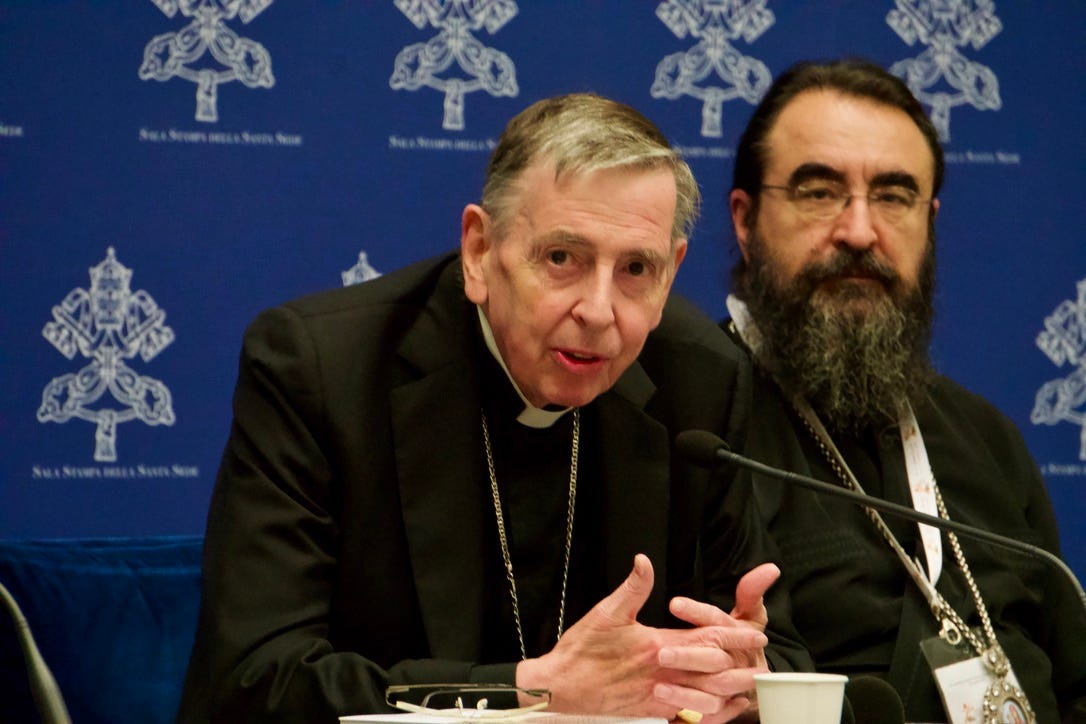
Writing his preface to the 150-page document, DPCU prefect Cardinal Kurt Koch noted that:
It is our hope that it will promote not only the reception of the dialogues on this important topic [the papacy], but also stimulate further theological investigation and practical suggestions, ‘together, of course,’ for an exercise of the ministry of unity of the Bishop of Rome ‘recognized by all concerned’ (UUS 95).
Indeed, The Bishop of Rome appears to present the blueprint for a new understanding of the papacy and papal primacy in the 21st century, an era marked by a focus on ecumenism and “synodality.” As noted in the document itself:
The following pages offer a schematic presentation of (1) the responses to Ut unum sint and documents of the theological dialogues devoted to the question of primacy; (2) the main theological questions traditionally challenging papal primacy, and some significant advances in contemporary ecumenical reflection; (3) some perspectives for a ministry of unity in a reunited Church; and (4) practical suggestions or requests addressed to the Catholic Church. This synthesis is based both on the responses to Ut unum sint and on the results of the official and unofficial dialogues concerning the ministry of unity at the universal level. It uses the terminology adopted by these documents, with its advantages and limitations.
Windswept House? Primacy or committees?
The document’s theological arguments and essays are followed by a summary along with “practical suggestions or requests addressed to the Catholic Church” regarding the future exercise of the office of the papacy. As with other elements of current ecclesial life, the text bears a peculiar resemblance to Malachi Martin’s Windswept House, in which the globalist and Masonic-aligned cardinals are attempting to force the “Slavic Pope” to resign by arguing that for him to do so would help the damaged unity of the Church, and improve relations between the (heterodox) bishops and the pope.
Though not aimed at forcing Pope Francis to resign – since he has approved of The Bishop of Rome and ordered its promulgation, the DCPU’s text appears aimed at changing the papacy generally, not at any pope in particular. The “principles for the exercise of primacy in the 21st century” present a change in understanding of the papacy which would be at the service of ecumenism and synodality, the text outlines.
Papal primacy, the DCPU’s text states, should be intimately linked with synodality – reflecting the current wave of thought sweeping through the Church at the instigation of Pope Francis. “A first general agreement is the mutual interdependency of primacy and synodality at each level of the Church, and the consequent requirement for a synodal exercise of primacy,” the DCPU’s text reads.
Another point agreed on by the numerous ecumenical bodies involved in writing the text is that the papacy should be understood in a new sense by opening the door to decentralization of power. In this light, a call is made for synodality to be effected by granting more power to the “regional” levels of the Catholic Church, and “a continuing ‘decentralization’ inspired by the model of the ancient patriarchal Churches.”
Moving on, the text then presents the “practical suggestions” from all the ecumenical dialogues and bodies involved, before adding a further couple of suggestions from the DCPU in particular.
Even before the concrete and “practical suggestions” are presented – giving the DCPU’s ecumenical assessment on how to increase ecumenical unity and synodality by changes to the papacy – the subtext is remarkably clear: in the modern “enlightened” age in which the Church now exists, and given the self-understanding of “synodality” which is now endemic, papal primacy should be quietly faded out.
First change: Primacy a historical fad?
First on the DCPU’s list of “practical suggestions” is a call for a “re-interpretation” of the teachings of Vatican I – the council which issued the dogmatic constitution PastorAeternus which outlines the primacy and infallibility of the pope, two ecumenical stumbling blocks. PastorAeternusreads:
We teach and declare that, according to the Gospel evidence, a primacy of jurisdiction over the whole Church of God was immediately and directly promised to the blessed apostle Peter and conferred on him by Christ the lord… Therefore whoever succeeds to the chair of Peter obtains by the institution of Christ Himself, the primacy of Peter over the whole Church.
These teachings appear to be in the crosshairs of the DCPU via The Bishop of Rome. They call for “a Catholic ‘re-reception,’ ‘re-interpretation,’ ‘official interpretation,’ ‘updated commentary’ or even ‘rewording’ of the teachings of Vatican I.” The document states that some of the contributors to its compilation have argued that Vatican I’s “teachings were deeply conditioned by their historical context, and suggest that the Catholic Church should look for new expressions and vocabulary faithful to the original intention but integrated into a communio ecclesiology and adapted to the current cultural and ecumenical context.”
“Deeply conditioned by the historical context,” should be interpreted as “no longer acceptable for the brave, modern world in which we now live.”
Second change: Stick to the diocese of Rome to ‘renew’ the papacy
Continuing the Windswept House theme, the DCPU presents its second suggestion for how to alter the papacy. Just as the scheming cardinals in Windswept House presented a forced papal resignation as a good thing for ecclesial unity, so also the DCPU presents a stripping of papal power as a means to “renew the image of the papacy.”
The DCPU issues a request for “a clearer distinction between the different responsibilities of the Bishop of Rome,” which would, it argues, aid his “ministry of unity.” This call includes the desire for how “other Western Churches might relate to the Bishop of Rome as primate while having a certain autonomy themselves” – arguably translated as “will the Pope please consider himself just the bishop of an important diocese, and allow other ‘primates’ to enjoy some equitable power like he does?”
Indeed, the DCPU goes so far as to make this very argument, removing the need for the customary interpretation of Vatican-style linguistics. “A greater accent on the exercise of the ministry of the Pope in his own particular Church, the diocese of Rome, would highlight the episcopal ministry he shares with his brother bishops, and renew the image of the papacy,” the DCPU recommends.
Third change: Ecumenism demands more synodality, including for the papacy
If it was not already clear that the two watchwords of the modern church are “ecumenism” and “synodality,” the DCPU makes such crystal clear in its third suggestion on how to reassess the papacy. The DCPU wrote that the theological dialogues involved in compiling the document had identified how “a growing synodality is required within the Catholic Church,” which would be evidenced by increasing the authority of bishops’ conferences. The text reads:
Putting an emphasis on the reciprocal relation between the Catholic Church’s synodal shaping ad intra and the credibility of her ecumenical commitment ad extra, they identified areas in which a growing synodality is required within the Catholic Church. They suggest in particular further reflection on the authority of national and regional Catholic bishops’ conferences, their relationship with the Synod of Bishops and with the Roman Curia.
At the universal level, they stress the need for a better involvement of the whole People of God in the synodal processes. In a spirit of the ‘exchange of gifts,’ procedures and institutions already existing in other Christian communions could serve as a source of inspiration.
Fourth change: More ecumenical meetings
Pope Francis has continued to champion the cause of ecumenical meetings between religious leaders throughout his papacy, increasingly linking it to the current Synod on Synodality. These encounters appear set to continue under the spirit of The Bishop of Rome, since the DCPU highlights them as its fourth recommended change.
“A last proposal is the promotion of ‘conciliar fellowship’ through regular meetings among Church leaders at a worldwide level in order to make visible and deepen the communion they already share,” the text reads. “In the same spirit, many dialogues have proposed different initiatives to promote synodality between Churches, especially at the level of bishops and primates, through regular consultations and common action and witness.”
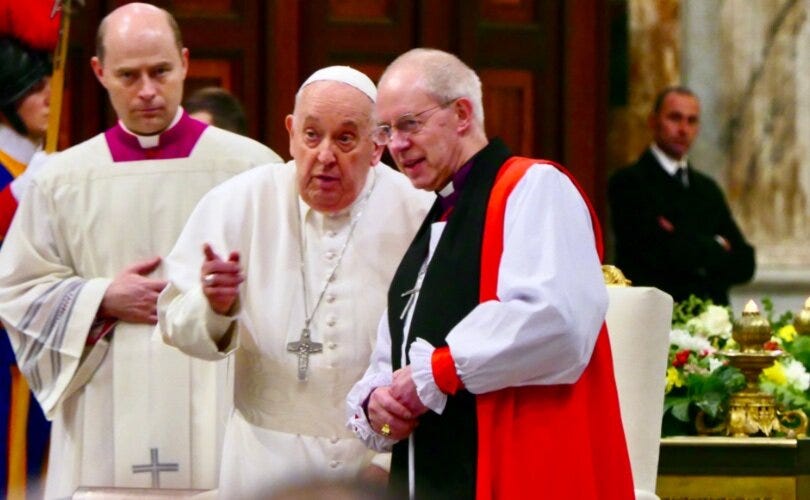
Commentators have long expressed concerns about the effect of such ecumenical meetings (like holding joint Catholic-Anglican vespers in the Basilica of St. Paul’s outside the Walls in Rome) since they create the impression that the Catholic Church and the Pope are on an equal footing with all the multitude of religions customarily represented at such events.
Pope Francis and Justin Welby at ecumenical Vespers, January 25, 2024. [Credit: Michael Haynes]
Speaking to this correspondent in Rome last year, Bishop Athanasius Schneider attested that modern ecumenism “undermines the truth that there is only one Church of God and this is the Catholic Church, the Church of Peter, united with the Holy See, the chair of Peter – the popes.”
While the Vatican heavily promotes interreligious actions, Schneider stated that “such gestures, or inter-religious meetings, are undermining these truths, and therefore these actions have to change.”
He added that Catholics must ensure that charity is always practiced with non-Catholics, but they must also inform non-Catholics “that they are unfortunately in an objective error, and that they are called by God to join the Holy Mother Church which is the Catholic Church, which is the will of God.”
Goodbye to the ‘universal Church’
Amongst the specific aims of the DCPU’s own direct recommendations, which conclude the text, is a peculiarly convoluted argument against understanding the Catholic Church as “universal.” “It seems particularly necessary to clarify the meaning of the expression ‘universal Church,’” the DCPU writes, employing another standard phrase, “clarify the meaning,” which is more correctly interpreted as “reject.”
The DCPU declared that “since the 19 century, the catholicity of the Church has often been understood as its worldwide dimension, in a ‘universalistic’ way.” This understanding, Cdl. Koch’s dicastery argues, “does not take sufficient account of the distinction between the Ecclesiauniversalis (the ‘universal Church’ in the geographical sense) and the Ecclesiauniversa (the ‘whole Church,’ the ‘entire Church’), the latter being the more traditional expression in the Catholic magisterium.”
By having “a merely geographical notion of the catholicity of the Church,” the DCPU wrote that a risk exists of “giving rise to a secular conception of a ‘universal primacy’ in a ‘universal Church,’ and consequently to a secular understanding of the extension and constraints of such a primacy.”
Instead, the DCPU urged a shift in the understanding of the universal Church and the power necessary to govern such a universal body. “Roman primacy should be understood not so much as a universal power in a universal Church (Ecclesia universalis), but as an authority in service to the communion between the Churches (communio Ecclesiarum), that is to the whole Church (Ecclesia universa).” That is to say, once the language is stripped away, the papacy should not seek to exercise its divine authority – the authority outlined in Pastor Aeternus – and instead work on using a restrained practice of power to foster ecumenical unity.
Conclusion
Tying all its many pages together, The Bishop of Rome concludes by urging the acceptance of the suggestions and recommendations made, in order to make a renewal – an unqualified renewal – of the “exercise of the ministry of the Bishop of Rome” and to further aid ecumenical unity.
“Building on the above principles and recommendations, which are fruits of common ecumenical reflection, it may be possible for the Catholic Church to renew the exercise of the ministry of the Bishop of Rome and to propose a model of communion based on ‘a service of love recognised by all concerned’ (UUS 95),” the text opines.
As is already widely documented, modern ecumenism has as its aim simple unity, not unity as outlined in the traditional teaching of the Church. For the papacy to become directly subordinated to the modern form of ecumenism would appear to be the next stage in a long process of ecumenical “walking together” – together, but away from truth."
In that article, I wrote about several conspiracies -- not theories, but actual conspiracies! -- including the unprovoked attack on the USS Liberty on June 8, 1967.
Now, the survivors of that murderous attack are calling for a congressional investigation into the deadly attack on their ship, and, perhaps, give some "closure" for those families who lived through the horror of their loved ones killed by a supposed "ally"...
Keep in mind that the sailors onboard the Liberty were told in no uncertain terms (threatened) to keep their mouths shut about the details of the unprovoked attack on their ship and the slaughter of their shipmates...
The coverup of the Israeli's military attack began at the top of our government and trickled down to the lower echelon, in other words, they had to obey or face retaliation from the corrupt powers that be.
The following article encapsulates and describes that horrendous attack and the efforts to bring some measure of justice to the survivors and their families.
“If the truth about the attack on the USS Liberty isn’t told to the American public, our Republic will fall. When your own government sets you up to be murdered, this speaks to the influence the Zionist state of Israel has with our politicians. Not one president from LBJ to Biden has lifted a finger nor has the Congress.” – Phil Tourney, USS Liberty attack survivor.
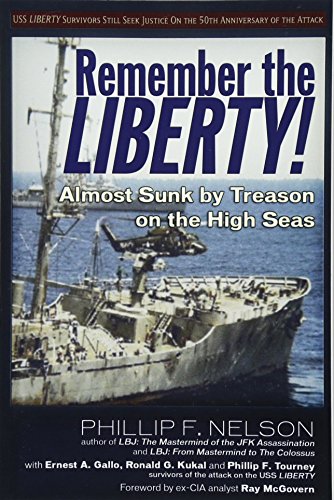
Now is the best time for Americans to demand an open and honest congressional investigation of the June 8, 1967 unprovoked and deliberate attack on the USS Liberty by the Israeli military. The brutal assault that killed 34 American sailors and wounded 171 of their shipmates was then covered up by Commander-in-Chief President Lyndon B. Johnson, military leadership, and Secretary of Defense Robert McNamara.Remember the Liberty!:...Phillip F. Nelson, Ron...Best Price: $12.75Buy New $10.00(as of 07:20 UTC - Details)
Many survivors and other analysts now conclude the attack was a planned false flag intended to sink the ship and kill all aboard as a pretext to gain public support for the US to join Israel in its battle against Egypt during the Six Day War. This is when Israel captured Gaza, the West Bank and the Golan Heights.
Eleven USS Liberty survivors, their wives and children, widows and children of the crew and supporters of the cause for justice for the USS Liberty travelled from all over America to gather in Arlington, Virginia for their annual reunion on June 7-8. For the first time, Arlington National Cemetery granted the survivors’ request for a presentation by the Navy color guard, the playing of Taps, and a Navy chaplain to lead prayer at the solemn ceremony at the gravesite of the USS Liberty Navy crew blown to bits by a torpedo, and slaughtered with napalm, cannon and gunfire.
The Israeli government’s genocidal actions against the Palestinians in Gaza since October 7, and the US government’s funding of weapons and arms to commit these atrocities, are awakening many who previously were incapable of psychologically process that Israel, supposedly America’s ally, could plan and perpetrate a deadly attack on an American ship, and that the US government could be an accomplice to this abhorrent betrayal. Author James Bamford, keynote speaker at the reunion banquet, said the bloody assault marked the point when the Israeli lobby, principally AIPAC, went into high gear to influence and control the US government.
In this photo, USS Liberty survivors stand behind the gravestone for their murdered shipmates. The survivors are left to right: Pat O’Malley, Rodney Dally, Wayne Hildebrand, Smitty Smith, Terry McFarland, Phil Tourney, Jim Cavanaugh, Moe Shafer, Larry Bowen, Ernest Gallo and Ed Bechtel. The gravestone lists only six of the 34 sailors who were killed due to the political pressure to understate the fatalities.
The reunion participants also paid their respects at the headstone of the ship’s captain.
The next day on June 9th a monument to the USS Liberty created by Cathy Meskel was dedicated in Norfolk, VA. See this.
The survivors and their families endure to this day the anguish and trauma of the horrifically violent attack. They live with the pain and hurt of the shockingly bloody nightmarish slaughter and the knowledge that their own government betrayed them.On the Psychology of M...Dixon, Norman FBest Price: $22.90Buy New $22.99(as of 05:02 UTC - Details)
“This reunion has meant as much to me as any previous year,” Tourney said. “Today to see the outpouring of support including from young people and to feel the spiritual energy in the room is inspiring.”
The other survivors present at the reunion were Moe Shafer, Ed Bechtel, Ernest Gallo, Larry Bowen, Terry McFarland, “Smitty” Smith, Wayne Hildebrand, Rodney Dally, Pat O’Malley and Jim Cavanaugh. Ron Kukal and Dan Pageler joined the group via live video. Ten survivors passed away this year while poor health and finances prevented other survivors from attending the reunion.
Bamford, author of “Book of Secrets” which features a chapter on the USS Liberty attack, and “Puzzle Palace,” noted no Hebrew interpreters were on the USS Liberty, a guarantee no one could figure out what the Israelis were talking about during their attack on Egypt.
Rick Wiles, creator of the masterpiece four-hour USS Liberty documentary “Sacrificing Liberty” also attended the event. The film tells the heart wrenching story of the attack from the perspective of the survivors and features archival film footage and photographs. To buy a copy of the CDs go here.
To learn more about this crucially important chapter of American history, national security and foreign policy, here is an interview with survivors Larry Bowen, Joe Meadows and Phil Tourney: