Unbelievably, he said the former!!!!!!!!!!!!!!!!!
From Hiraeth In Exile comes this astonishing news:
“God Became Bread”
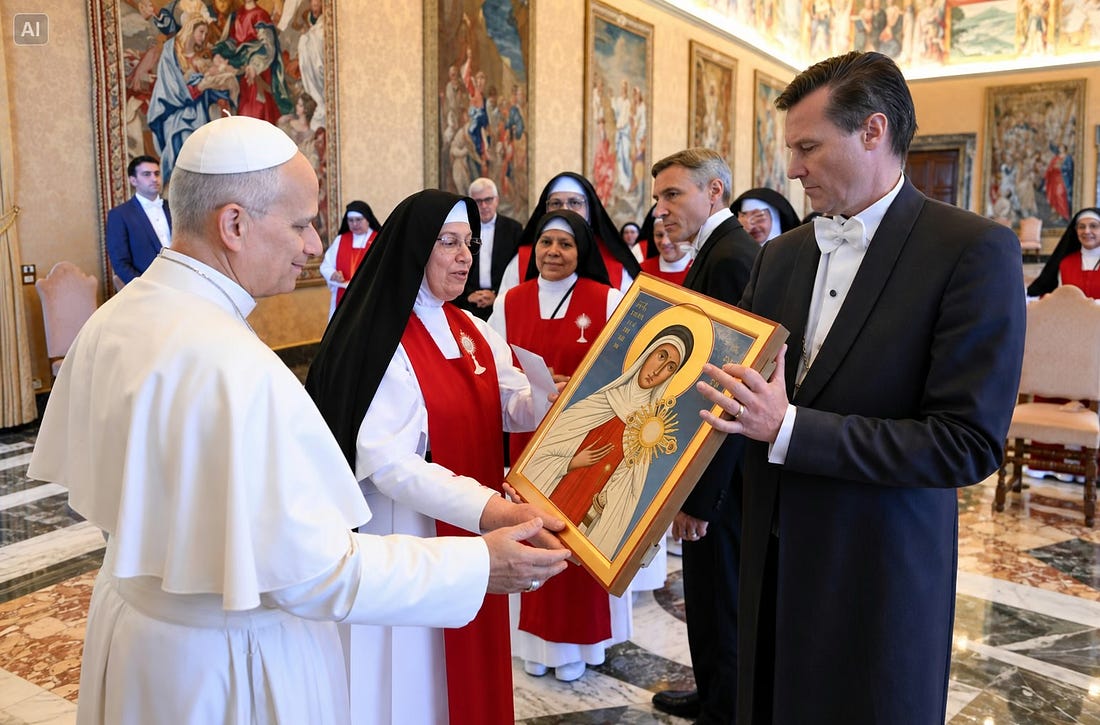 |
Leo’s September 5 address to the Perpetual Adorers of the Blessed Sacrament contains one sentence that deserves considerable criticism.
He praised their vocation as a life devoted to the silent adoration of “a God who became bread”—un Dio che si è fatto pane. Those are the words published by the Vatican itself.
God did not become bread.
The Word became flesh.
At Mass, the bread becomes the Body of Christ.
That distinction is neither pedantry nor a scholastic parlor game. It is the doctrine of transubstantiation.
The Council of Trent taught that at the consecration there occurs a conversion of the whole substance of bread into the substance of Christ’s Body. The appearances of bread remain. The substance of bread does not. The Catechism repeats the formula almost word for word.
Paul VI, of all people, stated it with admirable bluntness in Mysterium Fidei: after the consecration, “nothing remains of the bread and the wine except for the species.” Beneath those appearances stands an entirely different reality—Christ Himself, whole and entire.
So when Leo says that God “became bread,” the grammatical movement runs in precisely the wrong direction.
Bread → Christ.
Never Christ → bread.
Taken literally, Leo’s sentence is false. Worse, it brushes against the conceptual territory of impanation; the old error in which Christ is conceived as united to bread while bread somehow remains bread, after an analogy with the Incarnation. Catholic doctrine says something far more radical happens: the bread’s substance ceases to be there.
Perhaps Leo intended devotional poetry.
It is still an astonishingly irresponsible choice of words.
This was not an off-the-cuff remark to schoolchildren. He was addressing Perpetual Adorers of the Blessed Sacrament. If there were ever a room in which the man claiming the papal office should know exactly how to speak about the Eucharist, this was it.
And he spoke at a time when Eucharistic catechesis has already collapsed among enormous numbers of Catholics. The notorious 2019 Pew survey found that 69 percent of self-identified American Catholics chose the answer that the bread and wine are symbols rather than actually becoming Christ’s Body and Blood. A later CARA study produced somewhat better results when the questions were phrased differently, yet still found that 51 percent of adult Catholics failed even to identify correctly what the Church teaches about the Eucharist.
This is the environment in which Leo decided that “God became bread” was a suitable Eucharistic formula.
Why?
That question deserves asking.
One sentence cannot prove what Leo privately believes. We cannot climb inside his head and establish impanationist intent from seven Italian words. But neither are Catholics obliged to pretend that every doctrinally backward phrase from Rome is some innocent verbal hiccup requiring instant rehabilitation.
There are only so many times the faithful can be told that clearly defective language merely needs the proper “hermeneutic.”
Leo has theological training. He occupies the highest teaching office claimed in the Catholic world. His remarks are prepared, published and distributed internationally. He knows, or certainly ought to know, that saying “the bread becomes Christ” and saying “God becomes bread” are two very different propositions.
If he meant orthodox transubstantiation, he chose a remarkably stupid way to express it.
If he meant something more than metaphor, the problem becomes considerably darker.
For decades the post-conciliar Church has tolerated loose Eucharistic language precisely where ruthless precision was once considered necessary. “Meal.” “Assembly.” “Bread of fellowship.” “Jesus becomes bread.” The old vocabulary of sacrifice, propitiation, substance and conversion fades; warmer and more suggestive imagery takes its place.
Then everyone acts surprised when Catholics begin thinking the Host is bread.
Words teach.
Bad words teach badly.
And when the man presented to the world as the successor of Peter tells Eucharistic adorers that their God “became bread,” Catholics have every right to demand something better than another round of theological damage control."
End of this disastrous revelation...
Pray for the defeat of these modernist monsters -- especially Prevost -- and for their conversion to the Catholic Faith!
Viva Cristo Rey! Bl. Fr. Miguel Pro, Fr. Emil Kapaun, and Fr. Vincent Capodanno, pray for us...
St. Michael the Archangel, defend us in battle...
St. Joseph, pray for us!!
Gene DeLalla


No comments:
Post a Comment
Thank you for your comment.